
List of movies I watched in 2025.
I have lost interest in writing about every movie, but a movie popped up in the listings that the IMDB says I watched in 2022. I didn’t write about it at the time, and I can’t remember what I thought about it. I took this as a sign I should not watch it again, and also a sign I need to write more.
Trapped myself in a cage of my own making, yet again.
Thunderheart (1992)
arte, Deutsch
Always watch movies with original audio when it’s available: the voice actor for Graham Greene spoke a full octave higher than he does, and that was a distraction.
This film aired about a month before Val Kilmer passed away, but I DVR’d it because while I remember watching it with Mr Radish, I couldn’t remember the ending. Good watch about violence on Native reservations and corrupt FBI officials–it came out about the same time as the X-Files pilot was filmed, so I couldn’t help but make some comparisons in my mind. There was some chemistry between Kilmer’s FBI character and Maggie Eagle Bear, a local woman trying to improve the lives of her people, but no unnecessary sex scenes. Beautiful, if stark scenery and satisfying ending.
Yay!: Fred Thompson plays an FBI director in the first scene.
Changeling (2008)
arte Mediathek, original English
As I have learned from the Missing 411 podcasts, it was not uncommon in the 1920s for police to “solve” a missing-child case by giving the bereaved family a random found child of the approximate same age and hair color. One Los Angeles woman refused to accept this “solution” and was literally physically tortured by an officer uninterested in putting in the work to find her son, until her plight caught the attention of a radio preacher and a crusading lawyer. Based on a true story, written by the great JMS, and directed by Clint Eastwood. No happy ending, but an appropriate one.
Sets and costumes very fashionable for the time (perhaps unrealistically so). I can’t call it an “enjoyable watch” due to graphic violence and psychological trauma inflicted on women and children, but it was a good telling of an interesting story, and worth the time.
Modern Times (1936)
arte Mediathek, original English
Another pre-2019 rewatch, but I know more about film history these days so I appreciated it more. Chaplin keeps his Little Tramp and characters silent; impersonal speech from electronic devices (phones, radios, loudspeakers, etc) are the only words spoken. The version shown in the Mediathek was accompanied by the score that Chaplin wrote himself. Costar Paulette Goddard looked a bit too old to be under the jurisdiction of the child welfare authorities, but she dances beautifully, so who cares?
The “caught in the cogs of the machine” sequence is the most famous, but Chaplin roller-skating around the department store is genius.
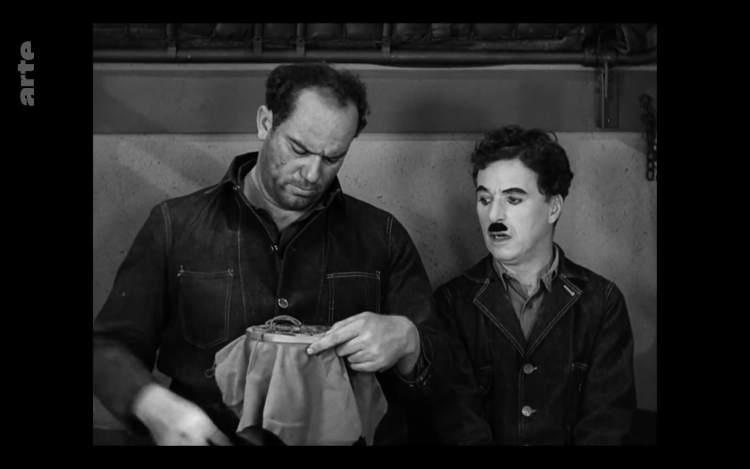
Embroidery?! The terror!!!
Fun fact: This movie was banned in Germany when it was released, ostensibly for the same reason Chaplin was denied re-entry to the US in 1952.
Zoolander (2001)
Paramount+, original English
The last time I saw this one I was recovering from hand surgery, and I while I’ve used half the memes since then, I’d forgotten the bits in between. Donald Trump has a cameo, on the red carpet of a VH-1 fashion awards show that I know was real because I was using VH-1 as my alarm clock in the summer of 2001, via the timer function of my TV.

I enjoyed it and I laughed out loud quite a bit. I need to find a young person to watch it with, to see if it’s generally funny, or just Gen-X funny.
Nacho Libre (2006)
Paramount+, original English
I had a vague notion of having enjoyed this one in the red-envelope era, but the rewatch was confusing. I previously had not realized it was made as a children’s film. Why was Nickelodeon producing films about Mexican orphans in a monastery? The obvious answer is, “the film is about a man leaving behind God for cheap spectacle and worldly acclaim and Viacom can make money off of kids who take the lesson”. But the female lead was very serious about devoting her life to serving God.
Confusing.
Anyway, all-Mexican cast except for Jack Black; filmed on location with great sets and costumes. Outwardly wholesome enough; comic wrestling violence. I laughed when I was supposed to, I guess, but I was also sort of horrified that it was a kid’s movie.
13. Juli 1944/13,5km (2011)
Deutsch/English/Boairsch, Asam Saal
A series of short films was presented in the Asam Saal as part of the city of Freising’s commemorations of the end of WWII (see previous remarks about the audience). I will summarize two here.
The filmmaker, Marcus Siebler, grew up in the 1980s in a village north of Freising, and as a child had heard rumors about Americans being murdered during the war, and as an adult he decided to learn if they were true. The film is the result of his research; he was able to get interview footage of 2nd Lt. Herbert F. Frels, the pilot, shortly before his death and also interviewed some Bavarians who had been living in the villages at the time. One of the men spoke Bavarian, and I only understood bits. Frels had a strong Texas accent, but the words were English. The interviews and historical photos/documents were interspersed with contemporary B-roll of the villages and buildings where the story took place.
On July 13, 1944, B-24 bombers from the 15th U.S. Army Air Corps took off from Italy to bomb a munitions depot near Munich and one, the ‘Gawgia Peach’, lost an engine and crashed. Most of the men parachuted out safely into Landkreis Kelheim and were turned over by locals to military authorities as POWs, and one was killed through parachute malfunction. Three of the men were unfortunate enough to land in Landkreis Freising, where they were murdered by men dedicated to the NSDAP cause, with the approval of the woman(!) running the county for the party. The men who did the killing were convicted by tribunals and executed at Landsberg; others involved were sentenced from a few years to live in prison–except one. He went underground until the occupation ended, then was tried and set free by a German civilian court. Tja.
You can read the whole story (in German) and see some images in this PDF from the filmmaker, which also describes how he conducted the research. There is a reference in this document to a second murder of downed US Airmen in Landkreis Freising a few weeks later–I have not come across any other information about that. (Don’t give me any of that “Liberation of Freising” shit–they were enthusiastic participants. The mayor was a member of the party since before the Beer Hall Putsch. They refused to rename “Adolf-Hitler-Straße” until the US Army did it for them. FFS.)
I recommend this film to anyone interested in WWII, but you’ll need to ask Mr Siebler for the version with English subtitles that he showed at the 50th (and last) reunion of the 485th Bomb Group Association.

I stole this image from FindAGrave.
It’s probably from the 485th Bomb Group Association Archives.
Anyway, back the movie reviews. 13,5km intersperses the memories of Xaver Neumeier of Hirnkirchen with contemporary B-roll of the streets in his story. He was 14 years old when the death march from Flossenbürg came through the Landkreis on the way to Dachau*, and he was hired by the “SSler” (which he pronounced “Siss-ler”) to drive a horse drawing a wagonload of bodies of men killed along the way. When the wagon was full, men were left on the side of the road.
The short film is 15 minutes of an old man sitting in front of a black background telling a sad and painful story in his own words. Men so hungry they tried to eat stinging nettles growing by the road; officers using dogs to chase down a man who tried to escape; men being shot when they couldn’t march fast enough. The villagers were, in his recollection, shocked by the terrible condition the slaves (I am tired of the weasel-word Zwangsarbeiter, “forced laborer”) were in, as they had been treating the men who had been assigned to their farms relatively decently, and also by how cold and brutal the SSlers were as they murdered men in their road.
The evening ended with footage of Xaver telling a few entertaining post-war anecdotes about his tractors and life in the Hallertau. He lived his whole life in Hirnkirchen, until his death in 2020.
*The photo at the top of this link, which is mostly about Poland, was taken in Hebertshausen, which is between here and Dachau.
Judgment at Nuremberg (1961)
arte Mediathek, original English/Deutsch
Please note: film contains archival army footage of the extermination camps, probably the footage I was shown in high school history class.
I had a lot of thoughts while watching this, most of which will get me deported. The *Americans* are considered the villains of this movie about civilians on trial for committing human rights violations on behalf of the NSDAP, and this attitude persists to this day I hear so much sneering in real life about the American occupation and “how it never ended” but between this film and the stories from Freising’s history, I’m starting to think the US let the Germans off way too easy.
Sorry. I forgot this is supposed to be a movie post.
All-star cast, and I didn’t recognize Judy Garland or Burt Lancaster in their roles. Their fake accents were off (Franconia has a different rhythm than Bavaria) but hair and makeup did great work. Dietrich, of course, is always recognizable, and it was strange to hear her character defend the people she fled from in real life.
Extremely well-made, and I recommend everyone see it once. But I was depressed for a few days afterwards.

Zoolander 2 (2016)
Paramount+, original English
Was supposed to be a palette cleanser, but outside of a few riffs on the music of Sting and some fan-service nods to the original, it was dreadful. It opens with a graphic scene of a celebrity–one I don’t care for, but that’s irrelevant–getting mown down with a machine gun, and ends with a satanic child sacrifice ritual, where the participants plan to eat the child’s heart to obtain eternal youth. What the actual hell?
Strangely the original–even with the cameos placing it firmly at the turn of the century, and the time-capsule feel of extinct traditions like “music television”–felt more timeless than the sequel.
Little Big Man (1970)
arte Mediathek, original English
Within a week, I noticed this Dustin Hoffman pic about a white boy adopted by a Cheyenne chief was playing in arte, cable, and one of our streamers. Does that mean something more than they all got the broadcast rights for cheap? Probably not.
In the first act, I expected this film to be a serious depiction of life in the Upper Plains as the frontier closed, but then the second act got silly–Faye Dunaway’s preacher-wife character came off as a parody–and as it twisted and turned, I couldn’t make any sense of genre. Perhaps that was the director’s point. (Spoiler) I lost all connection to the title character after he bangs his wife’s three sisters while she was off giving birth to his son, all alone on the prairie in the dark. Maybe that tells you more about me than about the Cheyenne, or Hollywood of the late 1960s.
Kind of bummed I didn’t recognize that General Custer was played by the Golden Girls‘ next door neighbor, Dr Harry. I have strong memories of watching Empty Nest on my grandparents’ giant wooden console TV.
Beavis and Butt-Head Do America (1996)
Paramount+, original English
Finally something to laugh at.
I am still incapable of separating films from the person I first saw them with, so I was a little sad at first, but then the gags started and I laughed and it was all good.
I recognized several catchphrases that I still use today, even though no one in this time or place understands that I am making a reference to a decades-old American film. Uh-huh-huh.
Beavis and Butt-Head Do the Universe (2022)
Paramount+, original English
Just as good as the original, and even the blatant social commentary was funny.
Tropic Thunder (2008)
Paramount+, original English
Rewatch; last viewing before the keeping of the lists in 2019. Some of the pop-culture gags need Shakespeare-style footnotes, or a Gen-X American on the couch next to you if you’re confused, but the critique of how Hollywood creates and sells actors and films as commodities still holds up.
(What happened to Stiller between this and Zoolander 2 that twisted him up so bad? Yikes.)
Raiders of the Lost Ark (1981)
Netflix, original English
Once again, a film I had never seen before, but had all the “forty years of cites, references, parodies, and praise” in my head. It was good, and what’s more: it holds up. Spunky female lead, decent effects, good plot. I’m glad Mr Radish forced me to watch this one (he wants to watch the fifth one together, but I have to catch up first.)
Indiana Jones and the Temple of Doom (1984)
Netflix, original English
I’m told this prequel was a bigger hit than the first one, but I did not like it at all. 1) Precocious kid sidekick; 2) the love interest was useless; 3) human sacrifice rituals to a dark god are not something I want in my home.
Some nice costuming on the background dancers in India, and IMDB tells me Kate Capshaw’s lounge singer dress was embellished with vintage 1920s beads. I still spent most of the film wishing Mr Radish had wanted to rewatch the Der Tiger von Eschnapur instead.
Charro! (1969)
Cable (Warner Film), original English
Finally, an Elvis pic that doesn’t suck. I’m not saying it was great, but it was a standard Western with standard plot and character elements and no cheesy musical numbers, and our hero won in the end. The organ-heavy mood music sounds dated, and Elvis’ five-day beard made him look a bit like Private Eyes-era Jason Priestley, but love interest Ina Balin was beautiful. Victor French (Highway to Heaven) plays a good villain, too. Who knew?
I’m glad he got to be a serious actor at least once.
The Ten Commandments (1956)
Paramount+, original English
I needed two nights to finish it, but it was worth the time. The invaluable Poseidon does a far better summary of cast notes than I ever could–it’s loaded up with frequent RadishFlixers. And check out the picture of little Fraser Heston with his parents (scroll down). Baby Moses was his only film role.
I thought it was great–loved the colors, the music, the somewhat pompous dialog. And the costumes–the special effects were cutting-edge for the time, but the film lives from the costumes.

LOOK AT IT.
Once more I’m angry I was given dumbed-down made-for-kids crap when I was growing up instead of being encouraged (or even allowed) to watch epic classics. I have a memory of asking to watch this one on television one Easter, fourth or fifth grade, and being told it was too old and boring to bother with. It’s obvious now my mother wanted to watch something else on a different channel instead (we did have three…) but I don’t know why she couldn’t just say that, instead of lying to me. It was on VHS at the library, the librarians would have let me check it out.
Sigh.
The Untouchables (1987)
Paramount+, original English
Unlike most of the Classic Films Everyone In My Class Was Allowed to Watch Except Me Collection, it’s better I saw this one as an adult, because at the time I certainly wasn’t interested in Prohibition, tax fraud, or film history.
Quite well-made, although not historically accurate. I am thinking again of Flicker: Your Brain on Movies, where I learned that people remember fake information from screens better than real information from text. I enjoyed it for what it is, superb cinematography. I was not expecting a Western scene, but that makes casting Kevin Costner make more sense. I also found myself thinking of Some Like It Hot during the banquet scene, although I don’t know if De Palma had intended that (his film is closer in time to SLIH than we are to his film).
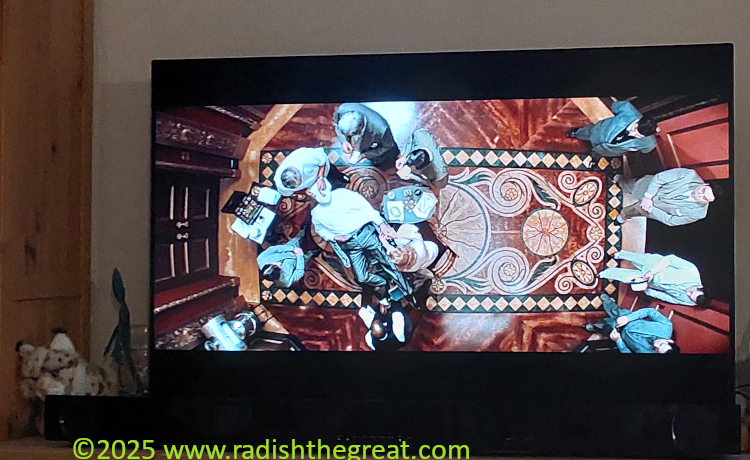
(I had hoped Diesel von Burgenwald would save the baby in the carriage. Lol, my brain.)
The Hole in the Wall (1929)

YouTube(PizzaFlix), original English
Most* films released in the US in 1929 entered the public domain this year, so I’ve got a giant list to get through. This crime drama was the beginning of Edward G. Robinson’s gangster persona, and Claudette Colbert is not yet a superstar and quite charming. She kidnaps the granddaughter of a woman who planted evidence to frame her for a crime, and while the story and characters were compelling enough, I didn’t need the minutes-long scene of the three-year-old mumbling a nursery-rhyme song. Audiences of the time loved their babies and baby-animals, I guess. The stuffed-shirt “journalist” who solved the kidnapping was also annoying. It’s only an hour of my life, though, and I was going to spend that hour sitting under my cat, regardless of what was on screen. I’ll recommend it if you’re into early talkies, or Robinson or Colbert.
Bonus: Donald Meek, the Pickles and Mincemeat Judge from 1944 State Fair, is part of the gang and I enjoyed seeing him as a younger man.
*I think there’s still a workaround where if a company re-released a version before this year, the copyright renews from that year, but the men behind PizzaFlix have secured all the streaming rights of all the films they make available.





2 Comments on “Merry Month of May Movies”