The fall slowly turns to winter. The time has come to dig into my stash of Lakota pumpkins and get my puree on. This absolute unit weighed in at 2248 grams and yielded 4 – 5/12 cups of puree.

October 2024
As you no doubt recall from last year: While the variety is named for the Lakota people, and it is often marketed as being of their heritage…it is a hybrid developed at the (sigh) University of Nebraska in the late 20th century, from some seeds donated by a woman who received them from a woman whose brother was a civilian employee at Fort Robertson, where the personnel had grown them since the late 19th century.
None of this affects the fruit’s excellent flesh or flavor.

October 2024
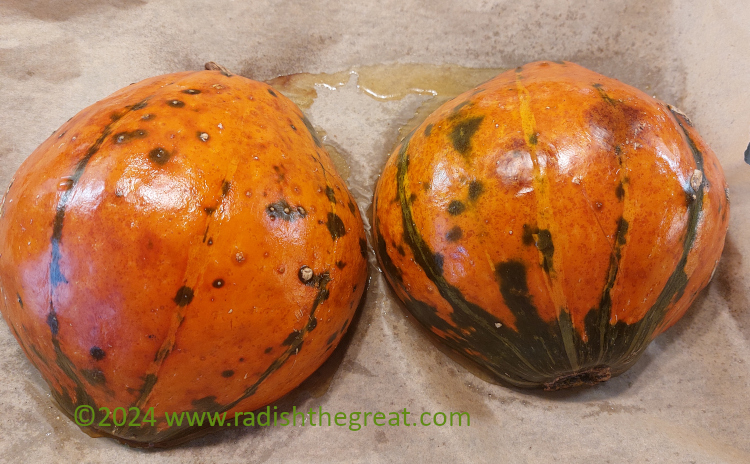
As usual, I roasted the halves cut-side down at 200°C for about 45 minutes (could have gone a few minutes longer at this size) after removing the seeds.

October 2024

October 2024
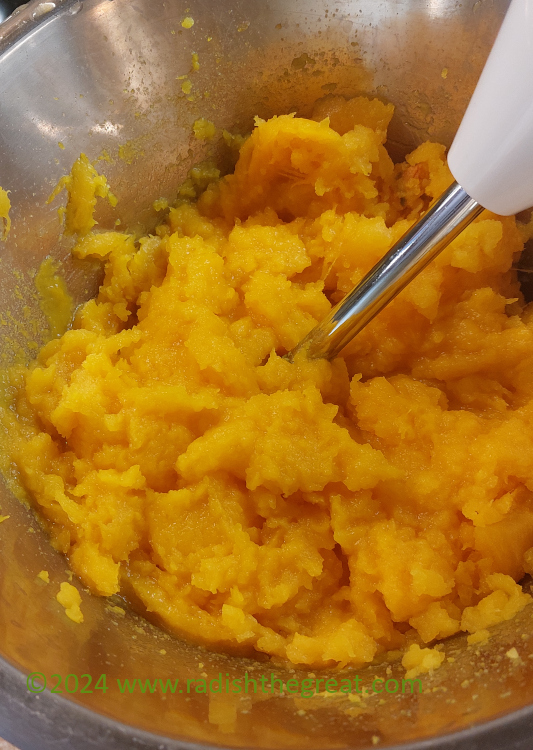
The flesh was then removed from the shell and pureed with my Stabmixer (I’m sure there’s an English word for this appliance, but it can’t be as fun as “Stab mixer”). I froze two cups for later use, and the rest went into the refrigerator.
October 2024
On to the Soup
In my flurry of research for Kürbisfest 2024, I came across a recipe for “Pumpkin Beer Cheese Soup“. “Beer Cheese Soup” is a staple of upper Midwestern winter menus that I had never made at home.
Long story short, “Pumpkin Beer Cheese Soup” needs some hyphens, because the word “pumpkin” modifies the word “beer”, not the word “soup”, which was not clear to me until I printed the recipe out and found “pumpkin ale.” Pumpkin-Beer Cheese Soup. Punctuation matters, people!
Since there is extremely limited pumpkin beer available in Bavaria (F’n Reinheitsgebot), I thought I’d just use a normal ale. Have you ever tried to buy ale in Bavaria? Ales are made with obergärige Hefe, top-fermenting yeast, at normal room temperature. Nearly all the beers produced in Bavaria that are not wheat beers are lagers, made with untergärige Hefe, bottom-fermenting yeast, at refrigerator temperatures (hence the existence of historic lagering cellars, aha!).
I haunted grocery stores for a week until I finally found a throwback to the pre-lager days: Riedenburger Historisches Emmerbier (they have a lovely Biergarten). Emmer is an ancient grain variety, a form of wheat that has not been hybridized, with a dark brown color and high protein content. That last phrase makes it a challenge for brewing, so this beer also has spelt (my favorite grain), wheat, and normal barley.
TL;DR: here’s the beer I used in this soup:

October 2024
The beer, along with some broth (I used chicken; vegetarians can use veggie), is used to cook a mix of leek, onion, and carrot until soft.

October 2024
Meanwhile, I made a white sauce of flour, butter, and milk, then added the pumpkin puree, then melted a metric boatload of store-brand Irish cheddar cheese into it (no pictures because I have to *concentrate* on white sauce).

October 2024
For the next step, the recipe says to combine the broth and the cheese sauce in a blender. I don’t have one, so I used my handy Stabmixer (such a great word). This did leave some recognizable bits of herbs and vegetables in the final soup; if you want it to be silky-smooth to impress a professional chef in a television cooking contest you will need a blender.
We like the bits, hyper-processed liquid meals scare us.
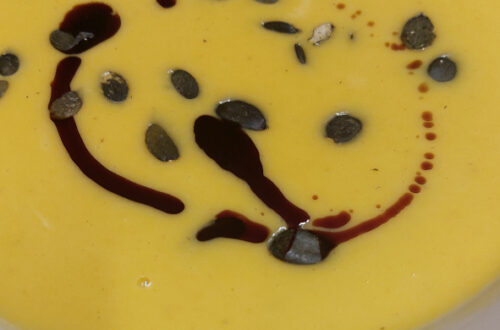
The black seeds are from the Ölkürbis, an Austrian pumpkin grown just for the seeds and their oil. I won’t call them a “healthy alternative to croutons” because I hate that sort of snide hectoring in a food blog, but they do have more vitamins and minerals than white bread. More importantly, they are extremely tasty.
The pumpkin flavor was subtle, the cheese was recognizable but not dominant, the beer wasn’t particularly recognizable, and there was plenty of umami.

October 2024
And it’s just that simple.
I have 3 – 2/3 cups of puree left.

October 2024


3 Comments on “Kürbisfest2024: Lakota & Beer & Cheese Soup”